
Grant Funding + Payroll: How Universities Can Simplify Reporting
Federal grant reporting has made payroll one of the most scrutinized functions in higher education finance. When a single employee’s time touches multiple funding sources, and the federal government requires documentation down to the percentage of effort, a spreadsheet-based payroll process creates both compliance risk and administrative burden.
For universities managing dozens of active grants, getting payroll allocation right is not optional. The consequences of errors range from audit findings to grant repayments to the suspension of future funding. A 2023 report from the Department of Health and Human Services Office of Inspector General found that payroll and personnel costs represent the single largest category of questioned costs in federal grant audits — ahead of equipment, travel, and indirect costs combined.
The root cause is almost never intentional misuse of funds. It is process: manual workflows, disconnected systems, and effort reporting practices that rely on estimates rather than actual documentation.
Summary
This post addresses the high scrutiny of payroll in higher education resulting from federal grant requirements under OMB Uniform Guidance. Compliance for universities requires documenting the distribution of employee time (payroll allocation) and certifying effort reports—the proportion of time spent on grants—at least semi-annually with contemporaneous records. We detail common errors, such as misallocating salaries based on budget instead of actual effort.
This article recommends best practices, including performing monthly distribution reviews and documenting every cost transfer with written justification. APS supports multi-source payroll distribution and configurable reporting, designed to simplify compliance for higher education institutions.
Why Grant Payroll Reporting Is Complex in Higher Education
University employees often support multiple projects simultaneously. A research associate might spend 40% of her time on a National Institutes of Health grant, 30% on a Department of Education project, 20% on an internal research initiative, and 10% on departmental teaching support.
Each of those funding sources has its own reporting requirements, allowable cost standards, and documentation expectations. The NIH grant has specific rules about which activities are allowable. The Department of Education project may have its own matching requirements. The internal initiative reports to the provost’s office on a different calendar than either federal award. And all of it runs through the same payroll system — or should.
Under the OMB Uniform Guidance (2 CFR Part 200), federally funded universities must maintain systems that can:
- Document the distribution of employee time by funding source
- Confirm that payroll charges are consistent with the work performed
- Support all charges with contemporaneous records
The phrase “contemporaneous records” is critical. It means documentation created at the time of the work, not reconstructed after the fact during an audit. Effort reports assembled from memory six months after the fact — even when accurate — do not satisfy this standard. Many university finance teams have discovered this distinction at precisely the worst moment: during an audit.
The volume and complexity of federal awards at major research universities magnifies this challenge. A single R1 university may manage hundreds of active federal awards at any given time, each with its own budget periods, reporting deadlines, and allowable cost definitions. The personnel costs on those awards typically represent 60 to 70 percent of total direct costs. Every payroll run is a compliance event.
The Uniform Guidance Standards for Payroll Allocation
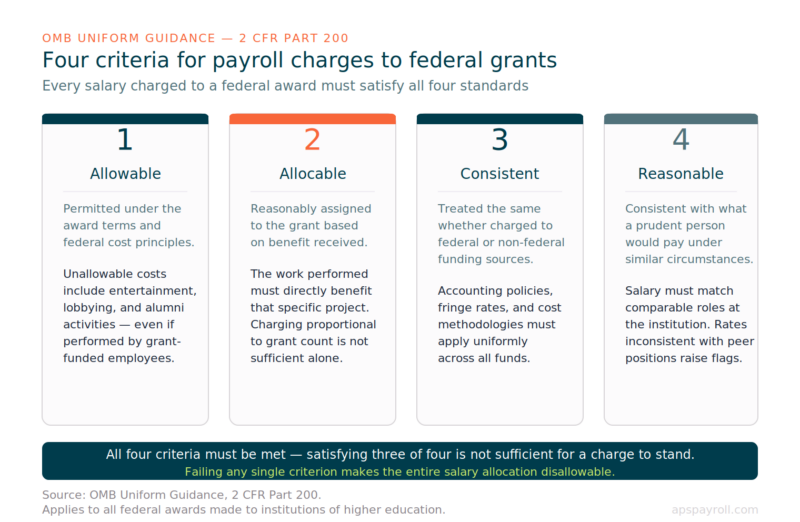
OMB Uniform Guidance establishes the standards for all federal awards made to universities. Under these rules, salaries and wages charged to a federal grant must meet four criteria: they must be allowable, allocable, consistent, and reasonable.
Allowable means the cost is permitted under the terms of the award and applicable federal cost principles. Not every salary cost is allowable on every grant. A researcher whose time is charged to an NIH award cannot include hours spent on fundraising, lobbying, or alumni activities — those are explicitly unallowable under 2 CFR Part 200. If an employee performs both allowable and unallowable activities, only the allowable portion can be charged to the grant, and the split must be documented.
Allocable means the cost can be reasonably assigned to the grant based on the benefit received. A salary is allocable to a grant when the work performed directly benefits that specific project. This sounds straightforward, but it becomes complex when an employee’s contributions are diffuse — a department chair who provides oversight across multiple projects, or an administrator who supports grant compliance broadly. Allocating salary in proportion to the number of grants someone touches is generally not sufficient without additional documentation of how time was actually spent.
Consistent means the cost is treated the same way whether it is charged to a federal award or a non-federal funding source. Universities cannot apply different accounting policies, fringe benefit rates, or administrative cost methodologies to federal grants versus institutional funds. If your institution capitalizes equipment over $5,000, that threshold must apply to federal awards too. Inconsistent treatment is a frequent finding in federal audits of university payroll practices.
Reasonable means the cost is what a prudent person would pay for the same goods or services under similar circumstances. For personnel costs, this typically means the salary is consistent with what the institution pays for comparable work in other contexts. Charging a grant at a rate significantly higher than what comparable employees earn — or billing for personnel whose credentials do not match the work described in the award — raises reasonableness concerns.
The most common audit finding related to payroll is charging a percentage of an employee’s time to a grant that does not reflect the actual work performed. This happens most often when initial effort estimates are used for payroll distributions and never reconciled against actual time.
Effort Reporting: What You Must Document
Effort reporting is the process of documenting and certifying the proportion of time employees spend on each activity, project, or funding source. Most federally sponsored research programs require effort reports at least semi-annually for key personnel.
Effort is expressed as a percentage of total professional activity, not clock hours. If a faculty member works 50 hours per week, 100% effort equals 50 hours. If she devotes 25 of those hours to a federal grant, her effort on that grant is 50% — regardless of whether 50 hours is more or less than her contracted appointment.
This distinction matters for faculty who work more than a standard appointment. A faculty member on a 9-month appointment who works summers on a federal grant must still express their grant effort as a percentage of their total professional activity during that period, which includes summer consulting, teaching, and research.
Requirements for a compliant effort reporting system include:
| Requirement | What It Means in Practice |
|---|---|
| Reasonably reflects actual effort | Reports cannot be based solely on budgeted percentages |
| Certified by the employee or a responsible official | A supervisor with direct knowledge may certify if the employee cannot |
| Prepared at least semi-annually | More frequent reporting is permissible and often better practice |
| Retained with grant records | Typically seven years from the final financial report |
One of the most persistent misconceptions about effort reporting is that the certified percentage must exactly match the payroll distribution. It does not. What is required is that any significant variation between the distribution and actual effort be identified and corrected in a timely manner. “Significant” is not precisely defined in Uniform Guidance, but most institutions treat a variance of more than 5% of total effort as a threshold that warrants review and potential correction.
Cost-Sharing and Matching: The Hidden Payroll Complexity
Cost-sharing — the portion of a project’s costs borne by the institution rather than the federal sponsor — adds another layer of payroll complexity that many universities underestimate at award setup and over-complicate during execution.
When a university commits cost-sharing on a federal award, those committed costs must be documented with the same rigor as the directly charged costs. If a PI commits 10% of her effort as institutional cost-share, and her salary is $120,000, that means $12,000 of institutional funds must be tracked, documented, and certified in the effort reporting system just as if it were charged to the federal award directly.
The most common cost-sharing payroll error is failing to document it at all. Institutions often make verbal commitments during the proposal stage and then never configure the payroll system to track the institutional contribution. When an audit asks for documentation of the committed cost-share, the finance team has no records to produce — which converts a paperwork gap into a disallowed cost.
A second common error is over-committing cost-share. When a PI promises more institutional effort than they actually contribute, the institution cannot document fulfillment of the commitment. Auditors who find systematic over-commitment — particularly in proposals to high-value sponsors — may interpret it as a pattern of misrepresentation rather than an administrative oversight.
Best practices for cost-sharing payroll management:
- Require approval from the grants management office before any cost-sharing commitment is included in a proposal
- Configure the payroll system to track institutional cost-share distributions alongside sponsored distributions
- Include cost-sharing effort in semi-annual certification alongside sponsored effort
- Reconcile committed cost-share against actual charged effort at each budget period closeout
Some funding agencies, including NIH, have significantly restricted voluntary committed cost-sharing on research awards. Verify the agency’s current policy before including cost-share commitments in any proposal budget.
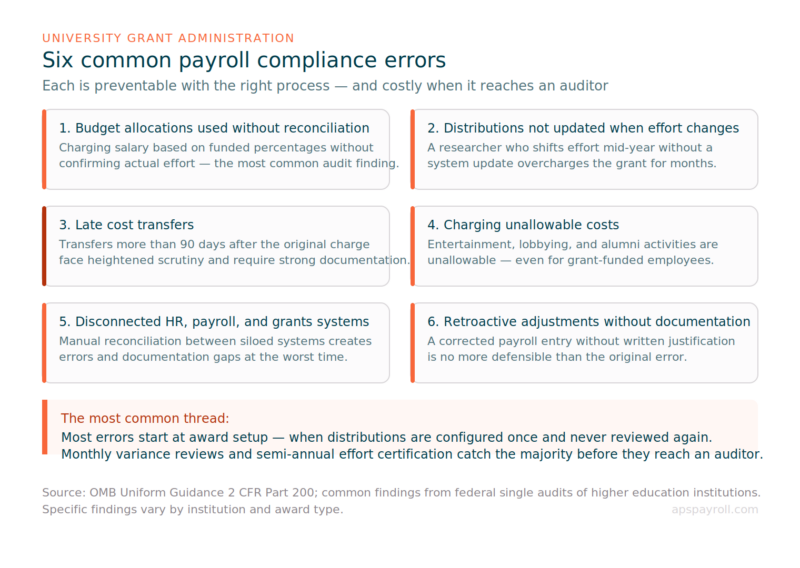
Common Payroll Compliance Errors in University Grant Administration
1. Using budget allocations as payroll distributions without reconciliation.
Many universities charge salaries to grants based on the funded percentage in the award, then never reconcile that to actual effort. At audit, auditors look for evidence that charges reflect actual work, and budget percentages alone do not provide it. The initial distribution is a starting estimate. Effort certification is the mechanism that confirms whether the estimate matched reality — and corrects it when it did not.
2. Failing to update distributions when effort changes.
A researcher who shifts from 40% effort on a grant to 20% effort mid-year, without updating the payroll distribution system, overcharges the grant for the remaining months. Retroactive corrections are difficult, require specific documentation, and may require grantor approval depending on the threshold of change. Effort should be monitored at least monthly and distributions updated prospectively whenever a significant shift occurs.
3. Cost transfers after the fact.
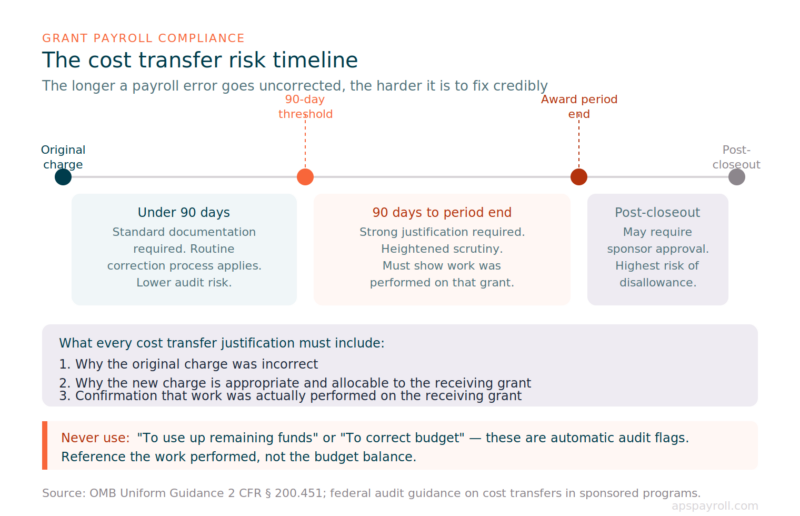
When payroll charges to a grant are incorrect, the corrective process is a cost transfer. The federal government scrutinizes transfers made near the end of the budget period, which signals retroactive correction to avoid unallowable costs. It also scrutinizes transfers without adequate documentation. A high volume of late cost transfers is a red flag in any audit. The 90-day rule — an informal but widely applied standard under which cost transfers made more than 90 days after the original charge are viewed with heightened skepticism — means that late discoveries are expensive to correct credibly.
4. Charging unallowable costs.
Certain costs are explicitly unallowable under Uniform Guidance, including entertainment, alumni activities, and lobbying. When these activities are performed by employees whose time is charged to a federal grant, the salary allocation creates an unallowable cost. Finance teams should maintain a written list of activities performed by grant-funded employees and cross-reference it against the unallowable cost categories in 2 CFR Part 200.
5. Lack of system integration between HR, payroll, and grants management.
When the grants management system, payroll system, and HR system do not communicate, the finance team manually reconciles data across platforms. This creates both errors and documentation gaps. An employee hire that is processed in HR but not updated in the grants distribution system can result in payroll running at the wrong funding source split for an entire pay period before anyone notices.
6. Inadequate documentation for retroactive salary adjustments.
When a PI discovers that a key person should have been charged to a grant at a higher rate in a prior period, the retroactive adjustment requires more than a corrected payroll entry. It requires written justification explaining why the work performed in the prior period supports the adjusted charge, evidence that the work actually occurred, and supervisory approval. Many institutions process the accounting correction without assembling the required documentation — which makes the corrected charge no more defensible than the original error.
How Integrated Payroll Systems Reduce Grant Compliance Risk
A unified payroll system that connects employee records, time distribution data, and payroll processing reduces the reconciliation burden and creates a cleaner audit trail. The goal is to get from a process where grant compliance is verified after payroll runs — through manual reconciliation — to one where payroll cannot run until distributions are configured correctly.
- Labor distribution reporting. The system should allow you to allocate an employee’s salary across multiple funding sources, generate reports by funding source for any period, and produce the documentation needed for effort certification. Reports should be exportable in formats that match the institution’s effort reporting and audit requirements, not just internal dashboards.
- Mid-period distribution changes. When a researcher’s effort shifts, the system should allow adjustments to be made prospectively with a clear effective date and a documented reason. The ability to record why a distribution changed — not just that it changed — is essential for audit defense. A field that captures the reason code for every distribution modification is a basic requirement that many legacy systems lack.
- Integration with the general ledger. Payroll distributions should flow to the GL without manual re-entry, reducing the risk of keying errors between payroll and the financial accounting system used for grant reporting. The GL account codes for sponsored awards, cost-sharing accounts, and departmental funds should be configured in the payroll system so that charges post to the correct accounts automatically.
- Audit trail. Every change to a distribution, every cost transfer, and every payroll run should be logged with timestamps, user IDs, and reason codes. This documentation is your first line of defense in an audit. When a federal auditor asks why a distribution changed in October, your answer cannot be “we think it was because the PI shifted efforts.” It needs to be a timestamped record with a documented reason, approved by an authorized user.
- Award period controls. The system should prevent payroll charges from posting to a grant account after the award period ends. Charges that fall outside the award period are automatically unallowable — and automated controls are far more reliable than manual review of award end dates across dozens of active accounts.
APS provides configurable payroll reporting that supports multi-source labor distribution and generates the detail reports that grant accountants need for compliance documentation.
Building a Stronger Grant Payroll Compliance Process
A well-structured process reduces both compliance risk and administrative burden.
- Establish distribution rules at award setup. When a new grant is awarded, set the payroll distribution in the system immediately, based on the funded effort in the budget. Do not wait until the first payroll run to configure the split. Awards that start processing payroll before distributions are configured default to departmental accounts, which then require cost transfers — creating the exact documentation problem you are trying to avoid.
- Create a calendar for effort certification. Semi-annual is the minimum. For grants with significant payroll activity or complex effort distributions, quarterly certification reduces the period over which errors can accumulate. Build the certification calendar into your grants management system so deadlines generate automatic reminders to PIs and department administrators.
- Train principal investigators on effort reporting obligations. Many audit findings result not from intentional misconduct but from PIs who did not understand what contemporaneous documentation requires. A 30-minute annual training for all new and active PIs — with documentation that the training occurred — is inexpensive protection against the most common category of finding.
- Review distributions monthly. Finance teams should compare budgeted effort to charged effort each month. A variance report that flags discrepancies above a threshold — for example, more than 5% difference between budgeted and charged effort — surfaces issues before they become audit findings. Monthly review also catches the common scenario where a research assistant who moved to a new project in August is still being charged to the old grant in September.
- Document every cost transfer with a written justification. Include why the original charge was incorrect, why the new charge is appropriate, and confirmation that the work was actually performed on the receiving grant. Never describe the reason as “to use up funds” or reference budget availability. Those descriptions are audit flags that invite additional scrutiny of the entire award.
- Conduct a pre-closeout reconciliation. At least 60 days before each grant period ends, compare all payroll distributions against effort certifications for the period. Identify any distributions that need correction while there is still time to process them within the award period. Post-period corrections are significantly harder to justify and more likely to attract audit attention.
Frequently Asked Questions
What is effort reporting in university grant administration?
Effort reporting documents and certifies the proportion of time employees spend on federally sponsored programs. It provides the documentation needed to support payroll charges to grants and is required under OMB Uniform Guidance. The certification confirms that payroll distributions reflect how employees actually spent their time — not just how they were budgeted.
How often do universities need to submit effort reports?
Federal requirements mandate effort certification at least semi-annually for key personnel on federal awards. Many universities certify quarterly for high-value or high-risk awards to reduce the period over which uncorrected errors can accumulate.
What is the difference between payroll distribution and effort reporting?
Payroll distribution is the technical process of allocating salary costs to specific accounts in the payroll system — it determines how each paycheck is charged. Effort reporting is the subsequent certification that those distributions accurately reflect how the employee actually spent their time. If the two diverge significantly, the distribution must be corrected.
What happens if a federal audit finds payroll allocation errors?
Consequences range from a formal finding requiring a corrective action plan to repayment of disallowed costs, suspension of award payments, and in serious cases, debarment from future federal funding. The severity depends on the nature of the error, whether it appears systematic or isolated, and whether the institution has a documented compliance program that demonstrates good-faith effort.
What is the 90-day rule for cost transfers?
The 90-day rule is an informal but widely applied standard under which cost transfers processed more than 90 days after the original charge are viewed with heightened scrutiny by federal auditors. Late transfers must be accompanied by unusually strong documentation explaining both why the original charge was wrong and why the correction is appropriate.
How long must universities retain payroll records for federal grants?
OMB Uniform Guidance requires financial records, including payroll documentation, to be retained for at least three years from the date of submission of the final financial report. Many universities retain records for seven years given the complexity of award closeouts and the possibility of audit extending beyond the three-year minimum.
Can a single payroll system manage both sponsored and non-sponsored payroll?
Yes. A well-configured payroll system processes all payroll through one system while distributing labor costs to the appropriate accounts — sponsored grants, cost-sharing accounts, departmental funds, and institutional accounts — based on the distribution rules configured for each employee.
Does APS support higher education payroll and grant reporting?
APS supports multi-source payroll distribution and configurable reporting. Contact our team to discuss how we support the specific compliance needs of higher education institutions.
Sources
- Department of Labor: A Guide for Indirect Cost Rate Determination
- Part 200 – Uniform Administrative Requirements, Cost Principles, and Audit Requirements for Federal Awards
- Section 200.430 Compensation – personal services.
- Section 200.306 Cost sharing.
- Department of Labor Grant Management Closeout Process