
Overtime Management in Healthcare: Balancing Compliance with Patient Care
Healthcare organizations face an overtime problem that most other industries do not. When a nurse calls in sick at 6 AM or an ER fills beyond capacity, you cannot simply close the service window. Patient care demands continue, and your team fills the gaps. The result is persistent, expensive, and legally complex overtime.
U.S. hospitals spend an estimated $8.3 billion annually on nurse overtime and premium labor, according to data from NSI Nursing Solutions. Managing that cost without compromising care or violating wage laws is one of the central payroll challenges in healthcare.
Summary
This post addresses the structural and costly nature of overtime in healthcare, outlining FLSA compliance requirements. We cover the specific “8 and 80” rule (overtime over 8 hours/day or 80 hours/14 days), which requires a written agreement with the employee. We also identify common exempt roles (e.g., physicians) and high-risk non-exempt roles (e.g., LPNs and CNAs).
To control costs and ensure compliance, best practices include real-time monitoring of hours, building float pool capacity, and auditing regular rate calculations to ensure non-discretionary pay, like shift differentials are correctly included. APS provides scheduling, time capture, and payroll in a unified platform to provide real-time labor cost visibility and automatically calculate the blended regular rate for overtime.
Why Healthcare Overtime Is Different
Most employers manage overtime as an exception. In healthcare, it is often structural. The factors that drive it include:
- Staffing-to-census ratios: Patient volume is unpredictable. Surges require additional coverage that cannot always be filled by new hires or part-time staff.
- Mandatory overtime policies: Some states require a minimum staffing ratio. If you cannot fill a vacancy voluntarily, mandatory overtime may be the only legal option.
- Certification requirements: Not every nurse can float to every unit. An ICU short-staffed at 11 PM cannot be covered by a general floor nurse without the right credentials.
- Shift structure: 12-hour shifts mean that one absence creates a 12-hour gap, not a 4- or 8-hour gap.
FLSA Overtime Rules for Healthcare Employers
Under the FLSA, most non-exempt healthcare employees must receive overtime pay at 1.5 times their regular rate for hours worked over 40 in a workweek.
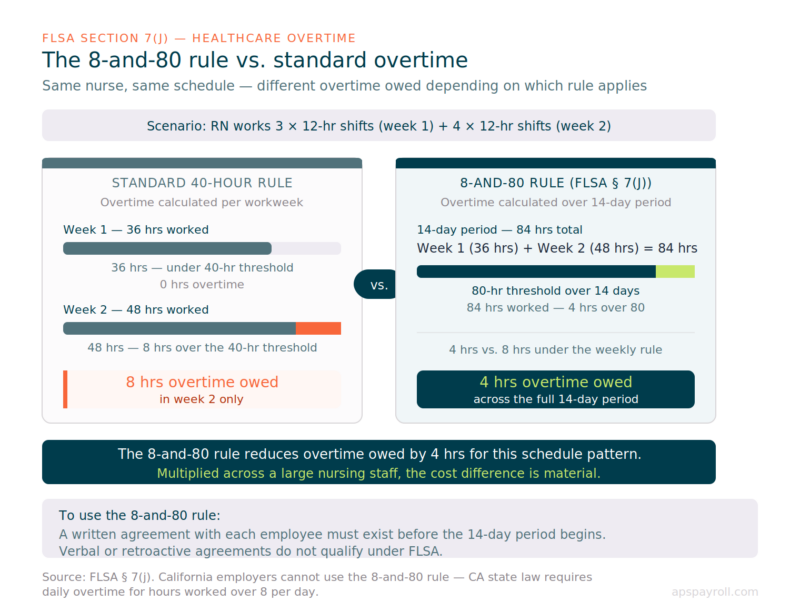
Healthcare employers also have access to the “8 and 80” rule under FLSA Section 7(j), which allows overtime to be calculated based on hours worked over 8 in a single day OR over 80 in a 14-day work period. This requires a written agreement with each affected employee before the work period begins. A verbal agreement or retroactive application does not satisfy FLSA requirements.
Which Healthcare Employees Are Exempt from Overtime?
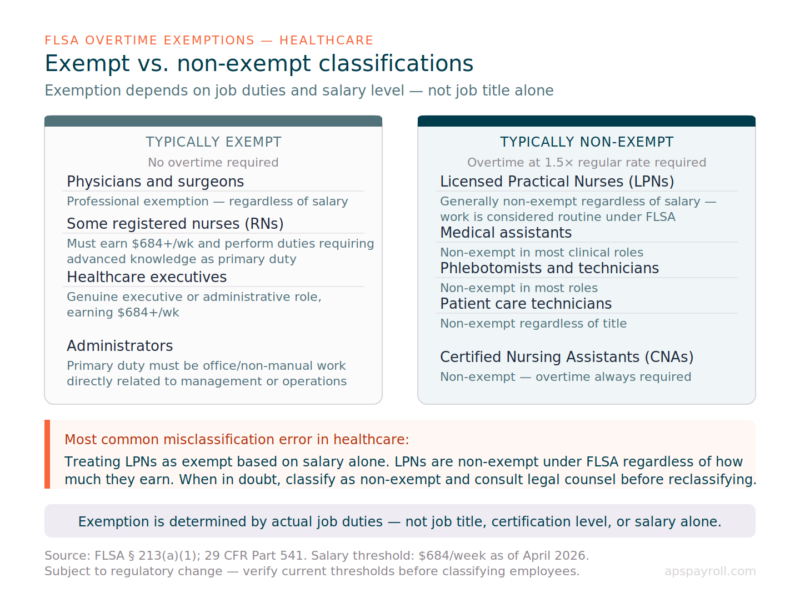
Not all healthcare workers are entitled to overtime. Common exempt classifications include:
- Physicians and surgeons (professional exemption, regardless of salary level)
- Registered nurses earning at least $684/week who primarily perform professional duties requiring advanced knowledge
- Healthcare executives and administrators earning $684+ per week in genuine executive or administrative roles
Common non-exempt classifications include LPNs (generally non-exempt regardless of salary), medical assistants, phlebotomists, patient care technicians, and CNAs. Misclassifying an LPN as exempt is one of the most common healthcare wage violations.
How to Control Healthcare Overtime Costs Without Sacrificing Care
- Forecast staffing needs more accurately. Historical census data, seasonal patterns, and admission trends give scheduling teams the information to staff more precisely.
- Build float pool capacity. A well-managed float pool of cross-trained employees reduces reliance on overtime by providing flexible coverage without the premium cost.
- Monitor overtime in real time. By the time overtime appears on a paycheck, it is too late to prevent it. APS integrates scheduling, time capture, and payroll so labor costs are visible in real time.
- Audit your regular rate calculations. Healthcare employees often receive shift differentials, on-call pay, and hazard pay. All non-discretionary pay must be included in the regular rate used to calculate the overtime premium.
- Review your FLSA exempt classifications annually. As job duties evolve and salary thresholds change, employees who were correctly classified last year may need reclassification.
A Practical Overtime Compliance Checklist
| Task | Frequency | Owner |
|---|---|---|
| Calculate overtime on blended regular rate (includes differentials) | Every pay period | Payroll |
| Verify 8-and-80 written agreements are in place | Before any new period begins | HR / Legal |
| Monitor daily and weekly hours against overtime thresholds | Weekly | Scheduling / Payroll |
| Review exempt vs. non-exempt classifications | Annually | HR |
| Audit compliance with state mandatory overtime restrictions | Annually or when laws change | HR / Legal |
| Pull overtime cost reports by unit vs. budget | Monthly | Finance |
Frequently Asked Questions
Can healthcare employers require employees to work overtime?
Under the FLSA, yes. Federal law does not restrict mandatory overtime (other than requiring overtime pay). However, at least 19 states have laws limiting mandatory overtime for nurses.
What is the 8-and-80 rule in healthcare?
FLSA Section 7(j) allows healthcare employers to calculate overtime based on hours over 8 in a day or over 80 in a 14-day period. It requires a written agreement with employees and must be established in advance.
Do shift differentials count toward overtime calculations?
Yes. Shift differentials are non-discretionary pay and must be included in the regular rate of pay when calculating overtime.
What are the penalties for healthcare overtime violations?
Penalties include back wages for up to three years, liquidated damages equal to back wages owed, and civil penalties for willful violations. Class action suits are common when multiple employees are affected.
How can payroll software reduce overtime liability in healthcare
An integrated time-and-attendance and payroll system applies the correct pay codes, calculates blended regular rates automatically, and flags overtime risk before the pay period closes. APS is purpose-built for the complexity of healthcare payroll.
Sources