
A failed HCM implementation does not announce itself. It shows up quietly: adoption rates that never climb, workflows that break down months after go-live, compliance gaps that surface during an audit. By the time the costs are visible, organizations have already absorbed them.
According to SHRM, inadequate training and poor change communication are among the top reasons HR technology implementations fail. The investment in the platform was justified. The execution is what fell short. This post outlines the six hidden costs of a poor HCM implementation and what a successful one looks like instead.
What Is an HCM Implementation Process?
An HCM implementation is the process of configuring, deploying, and training your organization on a Human Capital Management platform. It includes data migration, workflow setup, user training, and establishing the processes that keep the system running after go-live.
When executed well, an HCM implementation reduces manual work, improves data accuracy, and gives HR and finance teams the visibility they need to make strategic decisions. When executed poorly, it creates the exact inefficiencies it was supposed to eliminate.
Why HCM Implementation Quality Matters
The quality of your HCM implementation determines whether you see a return on your investment. Poor implementation delays ROI, increases support costs, and leaves your team working around the system rather than through it.
Whether you are switching vendors or adopting an HCM platform for the first time, the implementation process touches payroll, HR, time and attendance, benefits, and reporting simultaneously. That scope means problems do not stay isolated. A configuration error in one module creates downstream issues in others.
The stakes are high enough that it is worth understanding exactly what a poor implementation costs before you experience it firsthand.
The 6 Hidden Costs of a Poor HCM Implementation
The six hidden costs of poor HCM implementation are low employee adoption, operational inefficiencies, delayed return on investment, compliance and risk exposure, higher turnover, and missed strategic opportunities. Each one has a compounding effect: the longer a poorly implemented system runs, the more expensive each of these becomes.
The table below compares the typical outcomes of a poor implementation against a successful one:
| Dimension | Poor Implementation | Successful Implementation |
|---|---|---|
| Employee adoption | Low; team reverts to spreadsheets and manual processes | High; employees use self-service tools with confidence |
| Time to ROI | Delayed by months or years; platform becomes a sunk cost | Accelerated; APS customers average 12.81 months vs. 13.96 industry average |
| Compliance risk | High; incorrect tax setup, missing benefit rules, audit exposure | Low; configured correctly from day one with dedicated compliance support |
| HR workload | Increases post-launch due to workarounds and support tickets | Decreases; automation handles what was previously manual |
| Employee experience | Clunky onboarding, payroll errors, confusion about system access | Consistent onboarding, accurate pay, self-service access to benefits and pay history |
| Strategic visibility | Limited; workforce data is incomplete or inaccessible | Full; analytics and reporting are configured and in use from go-live |
Cost 1: Low Employee Adoption
Low employee adoption is the most immediate and visible sign of a poor HCM implementation. When employees cannot log in confidently, do not understand how to use the system, or find the interface harder than the process it replaced, they stop using it.
The result is that HR teams continue managing manually what the software was supposed to automate. Self-service tools go unused. Reporting dashboards sit empty. The platform collects subscription fees without delivering value.
SHRM research identifies inadequate training as the primary driver of adoption failure in HR technology deployments. The fix is not better software. It is a structured training program that begins during implementation, covers real company data, and continues after go-live.
Cost 2: Operational Inefficiencies
A poorly implemented HCM system often creates more work than it eliminates. Broken workflows generate support tickets. Inaccurate time tracking requires manual corrections before payroll can run. Benefits enrollment errors need HR intervention to resolve. Each of these is a task your team is now doing twice: once in the system and once in a spreadsheet or email thread to fix what the system got wrong.
These inefficiencies are hard to quantify precisely, but they are not invisible. They show up as overtime for your HR team during payroll week, as delays in onboarding new hires, and as frustrated employees who do not trust the system to get their pay or benefits right.
Cost 3: Delayed Return on Investment
Every month a poorly implemented HCM system underperforms is a month of ROI you do not recover. Platforms with low adoption cannot generate the workforce analytics and automation savings that justified the investment. The system becomes a cost center rather than a value driver.
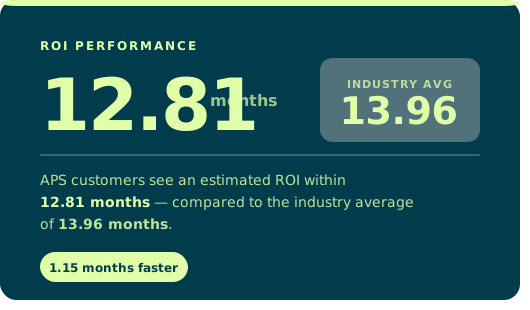
By contrast, a well-executed implementation accelerates ROI from the first payroll run. APS customers see an estimated return on investment within 12.81 months, compared to an industry average of 13.96 months per G2’s Mid-Market Results Index. That 1.15-month gap represents real dollars, not a rounding difference.
Cost 4: Compliance and Risk Exposure
Many organizations invest in HCM platforms specifically to improve their compliance posture. Poor implementation undermines that goal. Incorrect tax setup, missing benefit rules, or improperly configured ACA tracking can result in penalties that far exceed the cost of getting the implementation right the first time.
In regulated industries like healthcare and education, data accuracy requirements are even more stringent. An employee misclassified in a poorly configured system affects overtime calculations, benefit eligibility, tax filings, and ACA reporting simultaneously. One configuration error creates a compliance cascade.
Cost 5: Higher Turnover and Disengagement
New employees form their impression of an organization during onboarding. When onboarding relies on a clunky system, unclear processes, or frequent payroll errors, those employees disengage early. Disengaged employees leave sooner.
The cost of employee turnover averages between 50% and 200% of an employee’s annual salary, depending on the role and industry, according to SHRM research. For a mid-sized organization, replacing even a handful of employees annually due to poor experience is significant.
A well-implemented HCM system improves the employee experience from day one. Self-service tools that actually work, consistent and accurate pay, and easy access to benefits information are not perks. They are baseline expectations that affect whether employees stay.
Cost 6: Missed Strategic Opportunities
HCM platforms are not just payroll tools. They generate workforce analytics, track performance trends, support succession planning, and provide the labor-cost visibility finance teams need for accurate forecasting. An implementation that skips these modules, or deploys them without proper configuration and training, means your organization is paying for capabilities it is not using.
For HR Directors trying to build a strategic role within their organization, incomplete analytics data is a direct obstacle. You cannot bring workforce insights to leadership if the system that should generate them was never fully implemented. For CFOs, it means labor reporting still requires manual intervention, which defeats the purpose of the investment.
What Makes a Successful HCM Implementation?
A successful HCM implementation follows a structured, four-phase process executed with internal ownership and vendor support working in parallel. Organizations that treat implementation as a one-time technical event rather than a guided change management journey consistently experience the hidden costs outlined above.
The APS Guided Implementation Journey maps directly to the four phases every successful implementation requires. Here is how each phase works and why it matters.
Phase 1: Guided Setup
Before any configuration begins, define what success looks like for your organization. A dedicated implementation project manager guides this discovery: interviewing HR, payroll, finance, and operations stakeholders to understand their workflows, pain points, and expectations. The output is a personalized project dashboard that tracks all tasks, milestones, and timelines from day one.
Requirements gathered upfront prevent expensive reconfigurations after go-live. This phase ensures the system is built around how your organization actually operates, not a generic default. Your team should have full visibility into the implementation plan before configuration begins, with no surprises about what is included or when it will be delivered.
Phase 2: Platform Configuration
With requirements documented, the platform is configured with your organization’s unique data points: pay frequencies, department structures, benefit plans, tax jurisdictions, and compliance rules. This is where the hidden costs of poor implementation are either prevented or baked in.
A clear implementation plan documents every configuration decision, with assigned responsibilities and milestone checkpoints. According to Forbes, organizations that invest in structured implementation plans see significantly faster ROI than those that treat go-live as the finish line. Getting the configuration right the first time eliminates the cascading errors that drive Costs 2 through 6 above.
Phase 3: System Training
The gap between a deployed system and an adopted system is filled by training and change management. Employees need to understand what is changing, why it is changing, and what the new system makes easier for them before they engage with it.
The APS approach uses a guided learning path for all stakeholders: live training sessions on your actual company data, quick-reference guides, and dedicated Q&A opportunities for both administrators and end users. Training on real data, rather than generic demo content, means users build genuine confidence in the system rather than familiarity with an environment they will never see again. Multiple formats improve adoption across different learning styles.
Phase 4: Validation Testing
Accuracy is validated through testing and parallel payroll runs before your first live payroll is processed. This phase confirms that every configuration decision made in Phase 2 produces correct outputs under real payroll conditions.
The APS project manager stays with your organization through the first two live payrolls after go-live, providing direct support during the period when new-system questions are most likely to arise. After those first two payrolls, you transition to a dedicated ongoing support team. This handoff is structured, not abrupt.
Go-live is not the end of implementation. It is the beginning of the optimization phase. Collect user feedback in the first 30 to 60 days, monitor module adoption rates, and use that data to identify where additional configuration or training is needed. A vendor that assigns a dedicated post-launch team, rather than a general support queue, makes this phase significantly more effective.
Why Organizations Trust APS for HCM Implementation
APS’ Guided Implementation Journey is purpose-built to prevent all the hidden costs described in this post. The results are measurable:
-
95% of APS implementations are completed on time
-
92% of APS customers achieve high user adoption and ROI
-
91% of APS customers achieve their desired implementation results
-
98% customer satisfaction score
-
75 Net Promoter Score
APS Customer Satisfaction Rate
Net Promoter Score
These outcomes are not the result of faster timelines. They are the result of a structured four-phase process, dedicated project management, and a support model that does not end at go-live.
Every APS implementation includes a personalized project dashboard with full visibility into tasks, milestones, and timelines. Your dedicated project manager guides you through setup, configuration, and training, and then stays with you through the first two live payrolls before transitioning you to your ongoing dedicated support team. No case numbers. No general queues. No starting over with a new representative every time you call.
APS customers see an estimated return on investment within 12.81 months, compared to an industry average of 13.96 months per G2’s Mid-Market Results Index. That acceleration starts on day one of implementation, not after a rocky go-live.
FAQ: HCM Implementation Costs and Best Practices
How long does HCM implementation typically take?
Most HCM implementations for mid-sized organizations take between 8 and 16 weeks from kickoff to go-live, depending on the complexity of your payroll setup, the number of modules being configured, and the speed of data migration. Organizations with multiple pay groups, multi-state operations, or complex benefits structures should plan for the higher end of that range. APS builds a specific go-live timeline during requirements gathering, so you know exactly what to expect before implementation begins.
What is the number one reason HCM implementations fail?
SHRM research consistently identifies inadequate training and poor change communication as the top reasons for HR technology implementation failures. Employees who are not trained on the system or do not understand why the change is happening revert to their previous processes. The platform runs in the background while work continues in spreadsheets and email, which means you are paying for a system your team is not using.
What does a good HCM implementation timeline look like?
A well-structured HCM implementation timeline includes six phases: requirements gathering and project kickoff; system configuration and data migration; parallel testing and validation; user training; go-live with first payroll confirmation; and post-launch optimization. Each phase has defined milestones and assigned owners. Skipping or compressing any of these phases increases the risk of the hidden costs described above.
How do you measure HCM implementation success?
The most reliable indicators of a successful HCM implementation are employee adoption rate, time to process the first payroll accurately, reduction in HR support tickets post-launch, and time to ROI. APS tracks several implementation satisfaction ratings as benchmarks, with customers achieving a 95% on-time implementation rate. Internally, track the number of manual corrections required in the first 90 days post-launch. A well-implemented system should trend toward zero.
What compliance risks come from a poor HCM implementation?
A poor HCM implementation can lead to tax configuration errors that result in incorrect withholding, benefit rule gaps that affect ACA compliance, and time-tracking inaccuracies that create overtime liability. These risks are especially significant for applicable large employers (ALEs) subject to ACA reporting requirements and for organizations operating in multiple states with varying wage-and-hour laws. Getting configuration right during implementation is significantly less expensive than correcting compliance errors after they have been reported or audited.
Can a poor HCM implementation increase employee turnover?
Yes. Employees form their impression of an organization’s operational quality during onboarding. Clunky systems, payroll errors, and confusing benefits enrollment processes signal disorganization and erode trust early in the employment relationship. In a recent survey by the Sapient Insights Group, nearly 1 in 4 organizations report that their new HR tech implementations fail to meet adoption expectations. When an HCM implementation fails or is perceived as overly complex, it degrades daily work experience and directly impacts employee turnover. A well-implemented HCM system that delivers accurate pay, clear onboarding, and self-service access to benefits is a concrete retention tool, not just an HR efficiency measure.
How do you avoid the hidden costs of a poor HCM implementation?
Avoiding the hidden costs of a poor HCM implementation requires three things: choosing a vendor with a proven, structured implementation process; investing in thorough user training before and after go-live; and assigning internal ownership of the implementation rather than delegating it entirely to the vendor. The organizations that see the fastest ROI are the ones that treat implementation as a cross-functional project with executive sponsorship, not a background IT task.