
Every fall, HR teams spend weeks building open enrollment communications—emails, portal banners, all-staff meetings—aimed at getting employees to make a choice. But getting employees to choose isn’t the same as getting them to understand what they chose. Most organizations are optimizing for participation when the real bottleneck is comprehension.
If your open enrollment participation numbers look fine but your service tickets, 401(k) match rates, or benefits satisfaction scores don’t, the comprehension gap might be why.
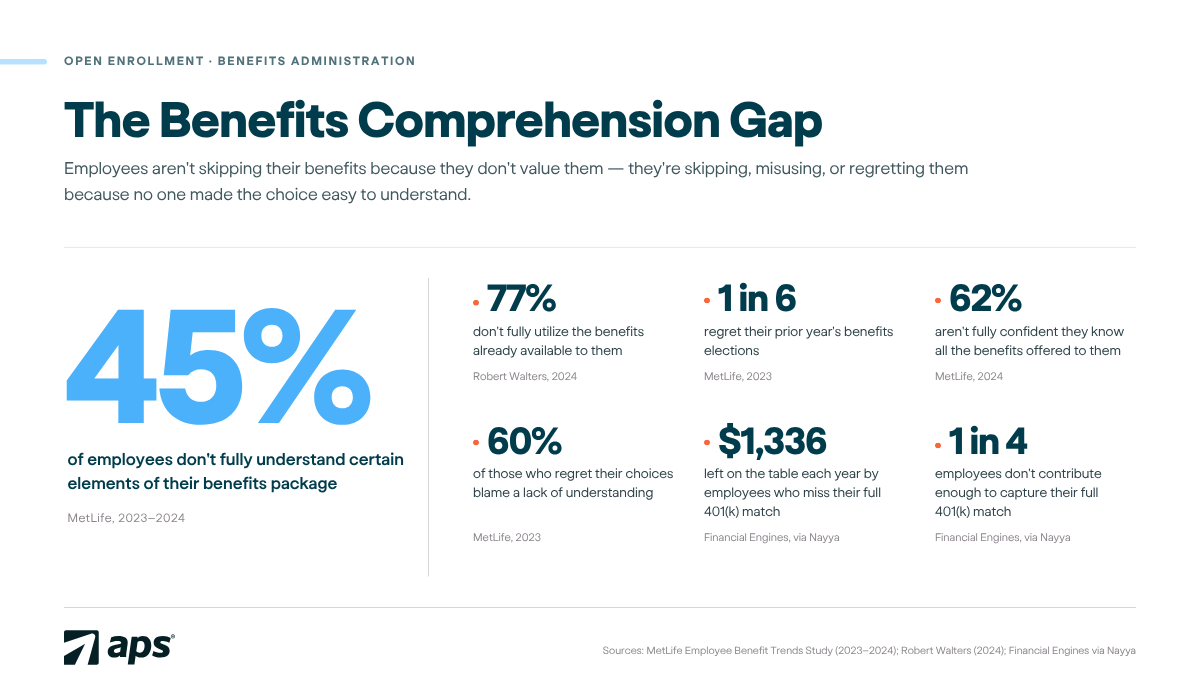
In short, 45% of employees don’t fully understand certain elements of their benefits packages, according to MetLife (2024; originally reported 2023). That gap shows up in two places: 77% of employees don’t fully utilize the benefits already available to them, and among the smaller group who do make an active choice, 1 in 6 regret it—60% of those citing a lack of understanding as the reason. The fix isn’t more enrollment reminders; it’s personalized, year-round education, built-in decision support, and self-service tools that make benefits easy to review anytime, not just during a two-week window each fall.
What is the benefits comprehension gap?
The benefits comprehension gap is the difference between the benefits an employer offers and what employees actually understand about them. Three stats define its size:
-
45% of employees don't fully understand certain elements of their benefits package (MetLife, 2024; HR Brew, 2023).
-
62% of employees are not completely confident they know about all the benefits and workplace perks offered to them (MetLife, 2024).
-
77% of employees don't fully utilize their workplace benefits (Robert Walters, 2024).
-
1 in 6 employees regret their prior year's benefits elections, and 60% of those who regret their choices blame it on a lack of understanding or information (MetLife, 2023).
Read together, the 77% and the 1-in-6 numbers tell a two-part version of the same story. Most employees are leaving benefits they already have on the table without ever making an active decision about them. And among the minority who do make an active choice, a meaningful share get it wrong—not because they chose carelessly, but because they didn’t understand what they were choosing between. Underuse and misuse are two symptoms of the same root cause: a lack of comprehension.
Why don’t employees understand their benefits?
Benefits have gotten more complex, not less.
Rising plan variety, HSAs and FSAs, and voluntary benefits stacked on top of core medical coverage all add more choice—and more room for confusion. As the Forbes HR Council put it in its 2026 guidance on navigating today’s more complex enrollment seasons, the sheer number of interdependent decisions has outpaced most employees’ ability to evaluate them confidently.
Communication doesn’t land, or doesn’t repeat.
Per the MetLife Employee Benefit Trends Study (via Milliman), 55% of employees want more individualized benefit suggestions, and nearly 70% of Gen Z workers want year-round messaging rather than a once-a-year push. That preference exists for a reason: a single email blast during a two-week window isn’t enough exposure for most people to actually absorb the information. It shows up in the numbers, too—roughly 30% of employees procrastinate on benefits decisions every year, and almost 40% wish they’d had more time to choose carefully (MetLife, via HRMorning).
Decision fatigue sets in fast.
Employees are typically asked to make several interdependent choices—medical, dental, vision, HSA/FSA contributions, life and disability—in a single sitting, often with no decision-support tools to lean on. As Flimp notes in its guidance on benefits decision-support design, that volume of simultaneous, high-stakes decisions is exactly the condition under which decision fatigue—and bad decisions—take hold.
What does the benefits comprehension gap cost?
The comprehension gap isn’t just an HR headache; it shows up on the balance sheet and in retention data alike.
Roughly 1 in 4 employees don’t contribute enough to capture their full 401(k) match, leaving an average of $1,336 a year on the table—close to $42,855 over 20 years (Financial Engines, via Nayya). On the flip side, comprehension pays off: more than three-quarters of employees who understand their benefits report being happy in their jobs, and over 80% say their benefits give them a greater sense of stability (MetLife, via HRMorning). Informed employees also participate at meaningfully higher rates—enrolling in HSAs at nearly three times the rate of uninformed employees (44% vs. 15%) and in retirement plans at a notably higher clip as well (70% vs. 52%) (Payroll Integrations, 2024).
Put simply: unused or misunderstood benefits are a sunk cost. The company is already paying for value that employees aren’t receiving—and that gap widens every year the comprehension problem goes unaddressed.
How can HR close the benefits comprehension gap?
-
Personalize, don't broadcast.
Segment communications by life stage or demographic instead of sending one blanket email—55% of employees are already asking for this. HUB International's "Workforce Persona Analysis" concept is a useful model for matching benefits messaging to different life stages and priorities.
-
Spread it out.
Move from a single enrollment-week push to short, timed touchpoints across the year. This addresses both the Gen Z appetite for year-round messaging and the procrastination problem noted above. One-on-one or manager-led conversations also consistently outperform static resources—roughly 80% of employees rate 1:1 conversations as very or extremely helpful, compared to about 70% for online resources (Optavise 2023 Healthcare Literacy Report, via HR Dive).
-
Build in decision support, and encourage consultation.
Comparison tools, cost calculators, and plain-language plan summaries give employees something to lean on besides guesswork—relevant given that employees who didn't consult anyone before enrolling showed measurably lower comprehension of what they'd chosen.
-
Use self-service technology to reduce friction.
Centralized portals and automated enrollment cut down on reliance on memory and one-time communications. APS' own employee self-service HRIS features and carrier connections capabilities are built around exactly this problem—giving employees one place to review, compare, and confirm their elections year-round, not just during enrollment week.
-
Follow up post-enrollment. Confirmation isn't comprehension.
A short "here's what you actually elected and what it means" recap addresses the root cause behind that 1-in-6 regret rate—60% of whom cite a lack of understanding—before it turns into a service ticket in February.
Closing the comprehension gap means closing the benefits utilization gap
The comprehension gap isn’t an employee failing to fix—it’s a process and communication design problem HR is well-positioned to own. Every stat above points to the same conclusion: employees don’t skip their benefits because they don’t value them; they skip, misuse, or regret them because no one made the choice easy to understand. Fix the comprehension gap, and benefits utilization follows.
If you’re building (or rebuilding) your open enrollment communication plan this year, start with APS’ Open Enrollment Guide & Checklist for Employers—or reach out to see how APS’ benefits administration platform can help close the gap for good.
Frequently Asked Questions
Q: What is the benefits comprehension gap?
It’s the difference between the benefits an employer offers and what employees actually understand about them. MetLife’s 2024 study reaffirms that 45% of employees don’t fully understand certain elements of their benefits package, and that lack of understanding is closely tied to underused benefits and enrollment regret, a figure first reported by HR Brew in 2023.
Q: How many employees don’t understand their benefits?
According to a 2023 MetLife study (reaffirmed in MetLife’s 2024 study) of more than 2,600 full-time U.S. workers, 45% report not fully understanding certain elements of their own benefits package.
Q: Why do employees regret their benefits elections?
MetLife found that 1 in 6 employees regret their prior year’s benefits elections, and 60% of those who regret their choices cite a lack of understanding or information as the reason, not a change in circumstances.
Q: What does poor benefits comprehension cost employers?
It shows up as an unused value: roughly 1 in 4 employees miss their full 401(k) match (about $1,336 a year each, per Financial Engines), and uninformed employees enroll in HSAs and retirement plans at far lower rates than informed employees do.
Q: How can HR improve benefits utilization during open enrollment?
Personalize communications by life stage, spread messaging throughout the year rather than a single push, add decision-support tools, use self-service technology so employees can review benefits anytime, and follow up after enrollment closes to confirm employees understood their choices.
Closing the benefits comprehension gap starts with this year’s open enrollment—not next year’s exit interview.
Sources
- HR Brew—Workers’ biggest open enrollment regrets, according to MetLife (2023)—45% don’t fully understand elements of their benefits; 1-in-6 regret rate; 60% of regret tied to lack of understanding
- MetLife’s 22nd Annual U.S. Employee Benefit Trends Study (2024)—reaffirms the 45% comprehension-gap figure; source of the 62% “not confident they know all their benefits/perks” stat
- HRMorning—Why Employees Struggle With Open Enrollment: 6 Ways to Help—MetLife data on happiness/stability correlation, procrastination (~30%), consultation gap (44%)
- Robert Walters—Employee Benefits Guide (2024)—77% don’t fully utilize benefits; communication satisfaction
- Payroll Integrations State of Employee Financial Wellness Report, via PSCA (April 2024)—education vs. participation correlation (401(k), HSA)
- Mercer—Do Your Employees Understand Their Benefits?—IFEBP employer-perception stat (<20%)
- Milliman—The power of personal touch in employee benefits communication—MetLife Employee Benefit Trends Study: personalization demand, Gen Z year-round messaging preference
- HUB International—2026 Workforce Vitality Gap Index / “Why Employees Aren’t Using Their Benefits”—EAP underutilization, demographic personalization (“Workforce Persona Analysis”)
- Nayya—Hidden Generosity: The Cost of Unused Employee Benefits—401(k) match losses
- HR Dive—Open Enrollment 2023: Need to Know—Optavise 2023 Healthcare Literacy Report (1:1 conversation vs. online resource helpfulness)
- Flimp—Avoiding Decision Fatigue: UX Design Tips for Benefits Decision-Support Tools—decision fatigue framing
- Forbes HR Council—13 Tips For Navigating Today’s More Complex Benefits Enrollment Season (2026)—plan complexity context